In my experience, booking a load for $2.00 a mile feels like a win until you calculate that your cost per mile is $2.18.
When we evaluated the industry standards, we found that that $0.18 difference means you paid $180 out of your own pocket to haul that load 1,000 miles. Multiply that by three loads a week and you are subsidizing the shipper’s supply chain to the tune of $540 weekly — $28,080 a year.
This is the most common and most preventable financial mistake in owner-operator trucking. Accepting loads based on spot market headlines without auditing your personal operating overhead is not dispatching — it is gambling with your operating capital.
Here is the actual rate-per-mile picture in 2026: what the market pays by trailer type, how to calculate your personal break-even number, and the specific tactics that push your average above the spot floor.
Why “good rate per mile” is the wrong question
Before we get into numbers, we need to reframe the question.
There is no universal “good rate per mile.” A rate of $2.30 per mile might be highly profitable for an operator with a paid-off truck, low insurance, and minimal deadhead. That same $2.30 rate might be a money-losing load for a new authority with a $1,800 truck payment, $1,400 in monthly insurance, and 20% empty miles.
The only “good” rate is a rate that:
- Covers your specific cost per mile
- Returns your target net profit margin
- Covers the deadhead miles you will run to pick up the load
Until you know your CPM, every rate discussion is guesswork. Learn how to track your numbers with our step-by-step walkthrough on how to calculate cost per mile.
How to calculate your personal break-even rate
Your break-even rate is the minimum dollar-per-mile you must charge to cover all expenses without making or losing money. The formula is:
$$\text{Break-Even Rate} = \frac{\text{Total Monthly Expenses}}{\text{Monthly Loaded Miles}}$$
Step 1: Add up your total monthly expenses
Include every cost:
- Truck and trailer payments
- Commercial insurance (auto liability + cargo + physical damage)
- Fuel (based on your average MPG and current diesel price)
- Maintenance reserves ($0.10 to $0.20 per mile)
- Dispatch fees (5% to 8% of gross revenue)
- ELD, compliance, IFTA, and UCR fees
- Accounting and bookkeeping
Step 2: Divide by your loaded miles, not total miles
If you run 10,000 total miles per month but 2,000 of those are deadhead (empty), your loaded miles are 8,000. Your costs apply to all 10,000 miles driven, but revenue only covers 8,000.
Example calculation:
| Expense | Monthly Amount |
|---|---|
| Truck payment | $2,000 |
| Trailer payment | $600 |
| Insurance | $1,300 |
| Fuel (10,000 miles @ 6.5 MPG, $3.60/gal) | $5,538 |
| Maintenance reserve ($0.15/mile) | $1,500 |
| Dispatch fees (6% of gross) | ~$1,440 |
| ELD, compliance, accounting | $350 |
| Total Monthly Expenses | $12,728 |
With 8,000 loaded miles: $12,728 ÷ 8,000 = $1.59 break-even CPM
Add a 20% net profit margin: $1.59 × 1.20 = $1.91 target rate per mile
Any load below $1.91 per loaded mile on this operation loses money or breaks even at best. The spot market averages listed below only become useful once you know your own number.
Use the Rate Per Mile Calculator to calculate your personal break-even and target rate automatically.
2026 spot rate averages by trailer type
These benchmarks are compiled from DAT Freight & Analytics transaction data and active broker quote surveys. They represent median national spot market rates — not the highest rates available, and not the lowest.
Dry Van
Dry van is the most competitive segment. Because the equipment barrier (a standard enclosed trailer) is low, capacity is high and rates are the most volatile.
- National spot average: $1.85 to $2.20 per mile
- Freight corridors with premium rates: Southeast to Midwest lanes, Northeast outbound, Texas to California
- Rate floor you should never accept: Anything below $1.75 per mile on a national average dry van haul is likely losing you money after fuel and deadhead. Running at these rates makes it impossible to maintain a healthy trucking profit margin.
The softness in dry van rates reflects overcapacity from the 2021 to 2022 boom cycle when thousands of new authorities entered the market. That overcapacity is slowly resolving, but dry van rates are not expected to normalize above $2.50 average until late 2026 or 2027.
Flatbed
Flatbed requires chaining, tarping, and physical labor that a dry van does not. The specialized skill and equipment barrier filters out casual operators.
- National spot average: $2.50 to $3.10 per mile (plus accessorial tarping fees of $25 to $100 per load)
- **Specialty flatbed freight (steel coils, oversized): $3.50 to $5.00+ per mile
- Best lanes: Manufacturing corridors (Southeast, Midwest), construction-heavy markets
Flatbed demand is closely tied to construction and manufacturing activity. In 2026, infrastructure project spending is driving flatbed demand in the South and Midwest, creating rate premiums on certain lanes.
Refrigerated (Reefer)
Reefer hauls have the highest operating cost of any standard freight type. Refrigeration units (Carrier, Thermo King) consume additional diesel and require constant monitoring, which justifies premium rates.
- National spot average: $2.60 to $3.30 per mile
- Temperature-controlled specialty (pharmaceuticals, produce): $3.00 to $4.50 per mile
- Best lanes: Florida produce to Northeast, California fresh produce to Midwest
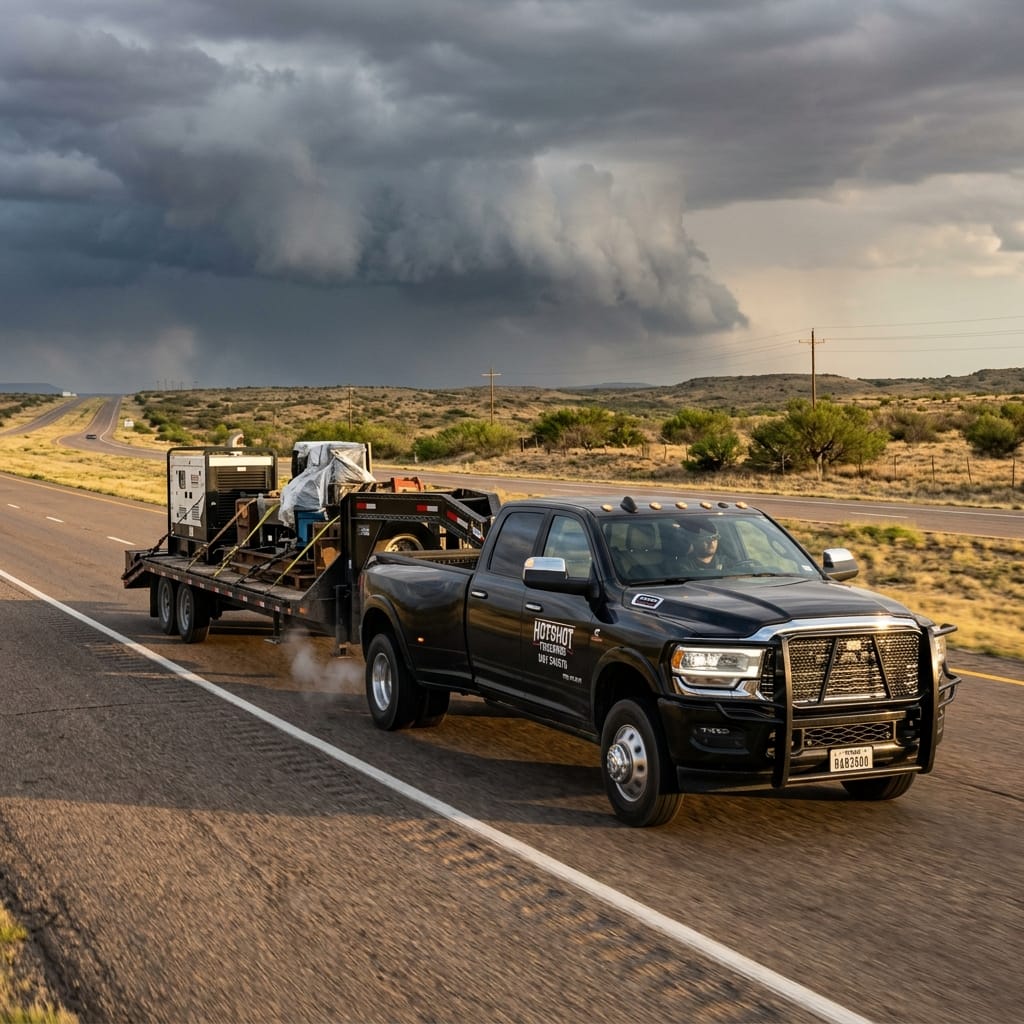
Hotshot (CDL Setup, Gooseneck)
CDL hotshot operators running a heavy gooseneck can command rates significantly above non-CDL setups because of the higher payload capacity and access to industrial freight that non-CDL trucks cannot haul.
- Non-CDL hotshot (standard dually, non-commercial weight): $1.70 to $2.00 per mile
- CDL hotshot (heavy gooseneck, 40 ft+): $2.20 to $2.80 per mile
- Hotshot specialized (heavy equipment, agricultural machinery): $3.00 to $5.00 per mile
The non-CDL hotshot market is currently saturated. Rates have compressed to the point where many non-CDL operators cannot generate sustainable margins after accounting for fuel and insurance costs. For a lane-by-lane regional breakdown, see our guide on hotshot trucking rates per mile.
The five strategies that push your average rate above the floor
The spot board reflects the desperation rate — what brokers can find at the last minute from carriers who need a load today at any price. Carriers who build systems around rate optimization do not live on the spot board.
1. Build direct shipper relationships
Shippers pay a premium for capacity reliability. If a manufacturer knows your truck will be at their dock every Tuesday morning, they will pay contract rates 15% to 25% above spot to avoid capacity risk.
Building direct shipper relationships takes 3 to 6 months of consistent on-time performance and proactive communication. But the payoff is significant: contract freight eliminates broker fees (typically 12% to 20% of load revenue), improves your rate, and reduces deadhead by creating predictable lanes.
How to start: Contact the transportation manager (not the shipping coordinator) at 3 to 5 shippers in your region. Offer a trial lane with competitive pricing. Document your performance and use it to negotiate a 90-day contract.
2. Specialize in freight that requires permits or skill
General commodity dry van is a commodity business. The more specialized your freight and the more skill your operation requires, the fewer competitors you face and the higher the rate floor.
| Freight Type | Required Skill/Equipment | Rate Premium Over Dry Van |
|---|---|---|
| Oversized/overweight (permits required) | Pilot car coordination, escort experience | +40% to +100% |
| Hazmat (HazMat endorsement required) | H endorsement, placards, safety compliance | +15% to +30% |
| Heavy industrial machinery | Heavy rigging knowledge, specialty chains | +30% to +60% |
| Agricultural heavy equipment | Farm lane contacts, seasonal expertise | +20% to +40% |
3. Enforce detention billing
Time is money. If a shipper takes 4 hours to load your trailer when the rate confirmation promised a 1-hour window, you have lost 3 hours of driving time and fuel-burning opportunity.
Standard detention rate: $50 to $75 per hour after the first 2 hours of free time.
To enforce detention, you need:
- Detention language written into every rate confirmation before you sign it
- Timestamped arrival records from your ELD
- A policy of invoicing detention immediately, not weeks later
Brokers will push back initially. Carriers who hold the line on detention consistently find that brokers route loads to them first, because reliable carriers who manage their time professionally reduce broker headaches.
4. Use fuel surcharges correctly
Many owner-operators ignore fuel surcharges or accept broker-set surcharges without negotiating. When diesel spikes above $4.00 per gallon, your fuel cost as a percentage of gross revenue climbs dramatically.
A standard fuel surcharge table adjusts your all-in rate by $0.02 to $0.04 per mile for every $0.10 increase in the diesel price above a base rate (typically $3.00 per gallon). Always confirm that the fuel surcharge on your rate confirmation reflects current OPIS diesel pricing in your operating region.
5. Eliminate deadhead miles systematically
Every empty mile you run costs you full fuel and wear without producing revenue. An operator running 20% deadhead on a 10,000-mile month is losing revenue on 2,000 miles. If fuel costs $0.55 per mile, that is $1,100 in monthly fuel expense with zero revenue return.
Tactics to cut deadhead:
- Build triangular lane networks instead of out-and-back routes
- Use load boards to search for backhauls before you deliver your current load
- Target freight corridors with balanced inbound and outbound traffic (avoid agricultural regions in off-season when empty miles spike)
What the DAT data doesn’t show you
DAT Freight & Analytics reports the median rate per mile across all transactions on its network. That includes carriers who accepted desperate rates to keep cash flowing, carriers in heavily competitive markets, and carriers with misconfigured search parameters.
The top 20% of owner-operators by revenue consistently earn 25% to 35% above DAT median rates on comparable lanes. They are not on different load boards — they have the same software you do. They have built systems around rate negotiation, detention enforcement, shipper relationships, and lane optimization that most operators never develop.
To benchmark your own performance and calculate your actual trip margins against your cost per mile, use the Trucking Profit Calculator before booking any load.
[!WARNING] Planning Disclaimer: Spot rate benchmarks are compiled from DAT Freight & Analytics published data and active broker surveys. They represent market averages and are not guaranteed future rates. This guide is designed for operational planning, not accounting. Consult a licensed CPA for tax and financial advice.
Frequently Asked Questions
What is a good rate per mile for trucking in 2026?
How do I know if a load is profitable before I book it?
Should I use spot market averages to price my loads?
How do I negotiate higher rates with freight brokers?
What is detention pay and how do I enforce it?
Conclusion
Determining what constitutes a good rate per mile depends entirely on your specific equipment type and operating expenses. A rate that is profitable for a non-CDL flatbed might mean bankruptcy for a Class 8 reefer operation. Track your personal cost per mile, analyze market lane averages, and maintain the discipline to walk away from cheap freight to secure a healthy, sustainable margin.